Monday, September 21, 2009

Foreign Hero of the Day: Captain Canuck

According to this article, Canada is the world's number 1 destination for foreign spies:

Led by the Chinese but including intelligence officers from at least 20 nations including allies [...], the infiltrators are stealing an estimated $20 billion to $30 billion annually worth of cutting-edge research in products and technologies, other scientific, business and military know-how and political secrets.

You know who this is a job for? Captain Canuck, that's who!

reprinted from joeshusterawards.wordpress.com

Captain Canuck, or Tom Evans, was a secret agent working for the Canadian International Security Agency (coincidentally in charge of counter-terrorism and intelligence), until he gained superpowers from some aliens. He then fought for justice in Canada in a fictional universe where it had become the most powerful country in the world and a haven for villainy.

Sure we all know Superman and we all care about Captain America, but not enough love is given to our boys fighting the good fight abroad. I say we take a minute to appreciate Captain Canuck's hard work rooting out terrorism and protecting all of Canada's national secrets. If only he were alive today to stop this threat...

Incidentally, I wonder what secrets Canada has to keep such that it's become such a nexus for foreign spies. Is it really, as the article claims, that it's just easy? Man, those spies are desperate. Even the comic had to invent a fictional Canada for it to make sense.

Hey US Government, Give Superman a Break from Paying Taxes!

reprinted from comiccoverage.typepad.com

What is this guy's deal? Superman's never been asked to pay taxes before because he's not really a United States citizen, is he? Clark Kent is a U.S. citizen. Clark Kent uses public education, roads, etc. And thus Clark Kent pays federal and state taxes. Superman, on the other hand, is not a registered citizen. He does not even really use public services. When was the last time you saw Superman driving a car down the street and paying tolls? Really, Superman's home isn't even in the United States at all. It's all the way up in the North Pole, where he can cleverly dodge U.S. tax laws.

By the way, "you owe the government a fortune in taxes" has the implication that somewhere in the catacombs of the federal government, there exists a file that details what Superman owes. They don't even know what he makes!

I guess it would be understandable if the United States government did not know that Superman had a secret identity at all. If they thought that he was just an alien who, after fighting robots and catching crazy tax collectors, goes to some apartment and flies away every time a bill shows up, then it might be reasonable to ask him to pay taxes. Of course, the only way to do this and preserve his secret identity would be some sort of flat tax system since no one has any idea what Superman's resources actually are. Not only that, but the government would have to employ more tax collectors like this one to show up at his doorstep--or to keep jumping off buildings.

But, come on. I thought that it was common knowledge that he had a human secret identity. Do people really think that he walks into a grocery store in his tights and picks up some potato chips? If not, then the government would be double taxing the poor guy.

Give Superman a break!

Ecocomic Recession Watch: Wayne Enterprises Edition

Batman and Robin #4 by Grant Morrison and Philip Tan (2009)

I bet we're all wondering how Wayne Enterprises is holding up during the recession. After all, many of the big comic businesses are in a bit of a slump. Stark Enterprises, for instance, is pretty much dismantled, albeit for reasons outside the scope of the recession and more in the vicinity of evil alien impersonators tarnishing Tony Stark's reputation. The Daily Bugle is now The DB and isn't doing too well either. Surely, Wayne Enterprises must have felt some shock as well. I mean, Bruce Wayne is conspicuously missing, leaving the burden of the day-to-day business to folks like Lucius Fox and Dick Grayson. Oh yeah, and let's not forget about Hush's diabolical charity scheme (I really do love saying that).

Despite all this, Wayne Enterprises has usually managed to keep enough prominence in the community. In fact, to my knowledge, the business has managed to provide Bruce and his family with enough dough to keep fighting crime for decades, almost without fail. Any catastrophic external event, economics related or otherwise, might at most temporarily affect operations, but it always seems to bounce back. Hell, Wayne Enterprises still is prospering despite a cataclysmic earthquake in Gotham that pretty much leveled the entire city to the point of the US government declaring it a dead zone (by the way, how many of you have read Batman Cataclysm and thought of me. Perhaps a post soon?)

Here, we have a scintilla of evidence suggesting that Wayne Enterprises might be affected by a combination of economics, bad press and shattered leadership. The shattered leadership refers to the real Bruce Wayne being missing and a fake Bruce Wayne handing out all of the company's resources towards questionable business ventures (such as novelty and games factories). The bad press calls back to Morrison's work in Batman R.I.P., where as part of the Black Glove's plan to nab the Batman, they had published phony stories regarding Thomas Wayne's legacy, depicting him and his wife as secret, deviant drug addicts. All of this would certainly go towards corrupting the company's legacy and affecting overall performance.

What about economics? Well, taking a quick glance at the wikipedia page for Wayne Enterprises, we see that the company has branches and subsidiaries dealing with several diverse elements of the market, including steel production, ship building, aerospace, oil and chemicals, biotechnology, electronics and entertainment. That is a huge behemoth of a company.

Though there have been many incarnations of the business (some writers have even portrayed the company as making a substantial amount from selling weapons and arms) and although many of you might think differently, I like to think of Wayne Enterprises as primarily a biotechnology and health-care firm. Thomas Wayne was conceived of the company as a means of doing the research and developing the technology to help as many people as he possibly could. After his death, Bruce continued the mission. It is no surprise that the cornerstone of the business is health-care related and that Wayne Technologies is, by far, the largest division of the company.

Though there's always money in health care, profits are probably falling. By how much, I don't know. But consider Amgen Inc., the world's largest biotech company, who reported ugly losses in the first quarter of 2009 (profits fell by 7.4%)

Here's one piece of data I found interesting regarding biotechnology and medical equipment. According to PricewaterhouseCoopers, investment in both has gone down. In fact, investment in biotechnology in the first quarter of 2007 was about $1.5 billion. In the first quarter of 2009, it was only about $577 million. For medical technology, it was $1.2 billion in Q1 2007 and $453 million in Q1 2009.

This means a lot for smaller firms, especially those struggling to compete against the big guns. After all, even huge pharma giants like Merck are now getting into the biotech game.

However, Wayne Enterprises is huge. Possibly too big to fail, even with missing CEOs and looming threats from villainous impersonators. Even though they will face losses, let's not forget that there are virtually no competitors in the DC Universe. Lexcorp used to provide considerable competition, but since Lex Luthor has been shamed and jailed, Wayne Enterprises bought it out. It is generally known as the provider of medical technologies and the biotechnology research firm of the DC Universe.

If Wayne Enterprises can survive an earthquake, alien attacks, and even armageddon, I think it can withstand the great ecocomic recession.

Friday, September 18, 2009

Be Back Next Week

reprinted from littlestuffedbull.com

I feel as overworked as Superman this week. Deadlines, report submissions, meetings, conferences, saving the world, curing poverty...AND blogging--it's hard work, you know?

Ecocomics will return next week to its regular schedule. So tune in. Same super time. Same super channel.

Tuesday, September 15, 2009

Department of Huh? Black Mask and Insurance Fraud

Batman #690 by Judd Winick and Mark Bagley (2009)

I am so puzzled here. Not only does the Black Mask's plan seems like an excessively convoluted one, but I'm wondering whether it is Judd Winick's intent to confuse the reader much like the Black Mask is intentionally trying to confuse Batman.

In the most recent Batman arc, the caped crusader engaged in a long battle with Clayface and Lyle Blanco on the streets of Gotham City, causing mass destruction along the way. Buildings leveled, cars exploded, and people ran.

According to the Black Mask, the city took out private contracts to cover insurance on a certain string of tenement buildings. However, the insurance company was actually a dummy corporation--wait for the twist--for no one! All of this, including the battle itself, was a cunning attempt to throw Batman off course.

Huh?

First, why and how is the city purchasing this insurance? Does the Black Mask have a marketing team under his employ so shrewd as to be able to persuade the city to trust this strange, unknown company? The other alternative is that the city is somehow involved with this villainous scheme.

Second, I'm confused as to what this dummy corporation actually is. To my knowledge, dummies are created as a front for other businesses in order to hide true ownership, avoid taxes, or fudge the numbers in the books. If this corporation is not a front, then is it an actual, functioning business? I think Black Mask probably meant that the city purchased insurance from a firm that does not really exist--possibly one that he fabricated himself.

I know that Gotham City is corrupt and indifferent, but this seems to stretch the extent of its irresponsibility.

Maybe Batman will figure this out, but Black Mask seems to have done a great job of bewildering me. That is why I'd like to ask the readers. Anyone have any ideas here or are you as confused as I am?

Friday, September 11, 2009

Chew, Elasticity and the Black Market For Chicken

Chew #3 by John Layman and Rob Guillory (2009)

Aw snap, Agent Savoy! You best not make those quips about government bureaucracy to the those health reform proponents.

Ironically, the organization that employs Agent Savoy and Agent Tony Chu (pictured above)-- Food and Drug Administration (FDA)--is anything but the paper-pushing, overly bureaucratic entity it's now stigmatized as on real-Earth. In the world of John Layman and Rob Guillory's Chew, the FDA has actually been granted extremely generous power, which includes the formation of its own Major Crimes Unit. During his first week of the job, Chu was held up at gunpoint by culinary terrorists (yes i just said that) and engaged in combat with a group of Yakuza smugglers in a shady sushi shop. Oh, there may be reports to fill out, but suffice it to say the FDA gets things done and kicks some ass doing it.

Why the sudden expansion of power? Well, in response to a recent bird flu epidemic, the United States government had decided to ban the legal sale of chicken and bird-related meats. Not unlike the market for illegal drugs and the market for alcohol during the US's brief experiment with Prohibition, the sudden moratorium of bird products had led to the development of a massive black market for chicken. Speakeasies and drug kingpins now smuggle drums of chicken in through the docks, sell them illegally on the street, and even use front businesses (such as sushi shops) to launder money. As a result, the government had granted the FDA the nearly unchecked ability to investigate all food-related crimes, many of them being violent ones.

However, one wonders whether this scenario would be as extreme as it is in the comic. Surely when a product is made illegal, black markets pop up. Yet in Chew, this black market is so large and organized that it warranted massive government funds to be used towards augmenting the power and scope of the FDA. I doubt that this would be the case.

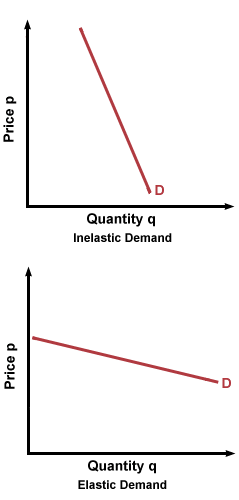
The reason is that the market for illegal drugs and the market for chicken are considerably different. Consider the demand for drugs. By and large, I would say that drugs are a pretty inelastic good. Basically, this means that consumer demand for drugs is not very sensitive to changes in price. That is, if the market price of a particular drug were to rise, individual consumption would not fall by a significant amount. A major factor of this, of course, is that hard drugs are massively addictive. Hardcore cocaine or heroin addicts tend to find ways of making more money so as to feed their addictions. A change in price is unlikely to deter them. This is why many proponents of legalization argue that the war on drugs using supply-side tactics (which increase price) are ineffective. Gasoline is another example of a highly inelastic good, particularly because there are few substitutes for it.

The price elasticity of demand for chicken, on the other hand, is more elastic for most consumers. The reason is that chicken is not as addictive as drugs are (except for maybe delicious delicious buffalo wings), but also because there are many substitutes for chicken: beef, fish, lamb, pork, and so on and so forth. This means that an increase in the price of chicken is likely to to cause consumers to look to other alternatives instead of expending more for the chicken. At the very least, consumers will be dissuaded to a much lesser extent than they would be for a change in price of illegal drugs or alcohol.

Elasticity is important in the case of Chew because it is a good predictor of the size of the black market. When a product is illegal, it becomes more expensive on the black market than it would be if it were legal and open up to free market competition. Consumers pay exorbitant prices for illegal drugs because suppliers have to figure risk, cost of illegal transportation, etc. into the cost of the product. Further, less competition means that sellers can charge higher prices and consumers will still pay so long as there are relatively few alternatives.

reprinted from sparknotes.com

So, if a product is relatively elastic (chicken), then if it is made illegal and prices on the black market skyrocket, those individuals will probably reduce their expenditures and seek substitutes. If a good is relatively inelastic (drugs), quantity demanded would decrease by a much less substantial amount.

All of this is to say that the black market for chicken in Chew is highly exaggerated. Though there would be many consumers who would be willing to throw down some hard-earned cash for a buffalo chicken sandwich or a grilled chicken Caesar salad, I believe this market size would not be so extreme and foment such a spark in violent crime that it would actually require a massive expansion of government authority.

The problem is that this means the FDA wouldn't be as badass. And this would be a horrible shame. I'm willing to suspend my disbelief for the benefit of getting to read about Yakuza fights, food psychics, left-wing food extremists, cop cliches, body parts in hamburgers, and so on.

September 11

I now realize that I probably should have posted yesterday's article (which had a lot to do with 9/11) today. Oh well.

For now, here is some wonderful art from Alex Ross (via ComicMix)

reprinted from comicmix.com
Art by Alex Ross